
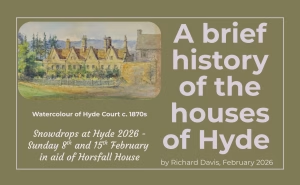
Our winter Open Gardens event in Hyde returns for 2026, offering visitors the chance to explore a beautiful collection of rare and striking snowdrops nestled within the private gardens of Hyde residents. But the gardens are only part of the story. The houses themselves are rich with history and local historian Richard Davis has created a fascinating feature about these remarkable homes.
A summary is provided below, and the full article is available to download below or in print from Hyde End during the event.
Hyde House Cottage
Believed to be a 17th‑century weaver’s cottage, it later became home to a spinner, an agricultural labourer and eventually formed part of the Hyde House estate. When sold in 1962, it gained additional land now home to the arboretum and horse enclosure.
Hyde House
Built between 1709 and 1715 by London attorney Daniel Clutterbuck, this house remained in the Clutterbuck family for 150 years. It was passed down through the family, including to a survivor of the Charge of the Light Brigade, until 1869 when it was sold to mathematician Joseph Bowstead. It was later home to the Legh family which included 23-times national ladies’ archery champion Alice Legh. The house was subdivided in 1958.
The Walled Garden
Thought to date back to the early 18th century, this garden once grew medicinal plants, fruit and vegetables, supported by an impressive heated wall and hot house. By the 19th century it was full of vineries, strawberries, asparagus and even a brick-built melon pit. The property was separated from Hyde House in 1964.
Ivy Cottage
Probably a mid‑17th‑century cottage with a long history of malting, it included a separate malt‑house and stables. It passed through several families of maltsters and may stand on land originally held by the same family since the 1630s.
Hyde Court
A manor house with roots stretching back to at least 1567. The current building was constructed around 1675 and later owned by prominent local clothiers. In the 1830s It was let as a boarding school for young ladies before returning, in 1869, to the Beale family, whose descendants included Dorothea Beale, the pioneering Principal of Cheltenham Ladies’ College. Her brother Henry was the last of the family to live there and the house was subdivided in 1948.
Hyde End
Built around 1790 by Miles Beale as a wool and yarn loft, this building later became stables, then part of a busy Edwardian household with gardens and billiard rooms. It was even used by the Air Ministry during the Second World War.
The full article is available to download here: Houses of Hyde 2026
For more information about the event, please visit our events page here

Thank you for supporting Horsfall House – every donation helps make a difference.